


Your First Fresh Flower Class: A Beginner’s Guide | Studio Blanc Taipei
Have you wanted to learn floral design, but still haven't booked a class?
Perhaps you worry that you have no eye for design, or the arrangements in photos feel far beyond your reach.
"I cannot even name all the flowers. Can I really do this?"
You do not need all the answers before walking into a floral classroom. Learning begins with getting to know the flowers in front of you, noticing the direction of a stem and gradually making an arrangement of your own.
Your First Fresh Flower Class: What to Expect as a Beginner
A first fresh flower class typically covers flower identification, tool use, an instructor demonstration, hands-on practice, adjustments and a final review. You do not need prior experience or to memorize every flower name. An introductory class helps you understand the materials, proportion, line and space, then complete your first arrangement with guidance.
Can I Join a Fresh Flower Class with No Experience?
Yes. Beginner classes start with flower materials, tools and basic composition. Demonstrations, practice and individual feedback guide you through a finished arrangement.
At Studio Blanc, you can begin with a fresh flower cake trial class. For a structured foundation, consider the BIACA Fresh Flower Beginner Certificate Course (in Chinese).
A trial class helps you discover whether you enjoy working with flowers. A full course uses different projects to develop your understanding of flower combinations, proportion, line and structure.
Your first lesson is not about making a perfect piece immediately. It is about understanding how flowers are prepared, selected and arranged. Once you see why a stem is left longer or a space left open, floral design becomes something you can practice step by step.
What Will You Practice in Your First Class?
The details depend on the day's project and available flowers. For beginners, the following are important parts of the learning process.
1. Get to Know the Flowers in Front of You
Some flowers make a natural focal point, some extend a line, and others connect the spaces between blooms.
Your instructor will guide you to observe flower shapes, stem characteristics and natural growth directions, and explain how to trim, prepare and use each material.
You can learn the names gradually. Noticing each flower's character first gives you a clearer basis for your design choices.
2. Watch a Demonstration and Understand the Choices
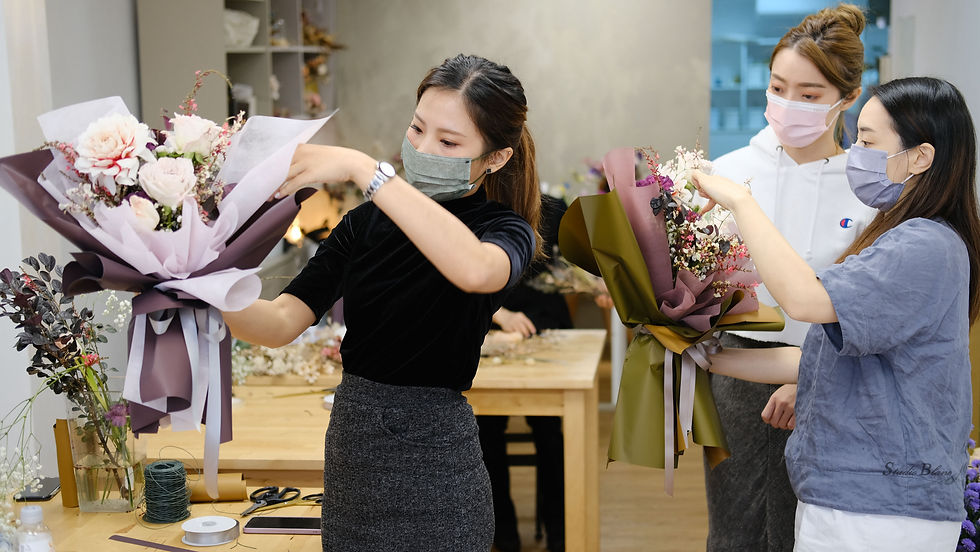
The height, placement and direction of each flower affect the overall proportions.
Why leave this stem a little longer?
Why does this area need space?
Where should the focal flower go to create balance?
Watching a demonstration is also an exercise in observation. Beyond the steps, you begin to understand the relationship between the flowers and the composition.
3. Make Your Own Arrangement with Individual Guidance

Even after understanding a demonstration, working with your own hands can feel challenging.
A flower may sit differently than you imagined, colors may gather on one side, or adding more flowers may make the arrangement feel crowded.
These are normal parts of learning.
Your instructor will respond to your arrangement as it develops, help you see what needs adjusting and invite you to try again. Understanding often grows through small changes: trimming a stem, changing an angle or moving a flower.
4. Step Back and Review Your Finished Work
Once your arrangement is complete, take another look:
Where does your eye go first?
Is there breathing space between the flowers?
Do the proportions still feel balanced from another angle?
Learning to see the state of your work is the starting point for your next creation.
You do not have to perfect every detail in your first class. Leaving with something you made yourself, along with a few methods you understand, gives you a direction for further practice.
Will It Be Difficult If I Have No Eye for Design?
An eye for design can develop through observation and practice.
At first, you may only know that an arrangement "looks beautiful." With practice, you begin to recognize its colors, proportions and lines, and see how to adjust your own work.
Everyone learns at a different pace. Some people notice color combinations quickly, some enjoy naturally extending lines, and others need a few more attempts to find their feel for the materials.
A beginner course provides a clear sequence of practice, so each project gives you something understandable to build on.
Trial Class or Beginner Certificate Course: Which Should You Choose?
Want a first taste of floral design? Start with a fresh flower trial class to get to know the studio and teaching approach.
Love fresh flowers and want structured learning? Choose the BIACA Fresh Flower Beginner Certificate Course to practice different arrangements.
Planning further study or floral gifts? Build a foundation in fresh flower design and develop your ability to create finished work.
Still comparing courses? Discuss your goals with us before choosing fresh flowers, bouquet wrapping or preserved flowers.
You do not have to decide whether to become a florist before your first lesson.
Understanding what you enjoy and what you want to make time for will help you find a suitable way to learn.
For structured study, explore the BIACA Fresh Flower Beginner Course. To compare options, see the Studio Blanc course overview. These course pages are in Chinese.
Can I Take Classes If My Schedule Changes?
Studio Blanc's fresh flower beginner course is scheduled by appointment. We can discuss a learning pace around your available times, subject to the studio's actual availability.
Let us know if you need to coordinate work, school drop-offs or travel from another city. Finding a rhythm you can maintain helps you work steadily through the course.
Learning can become part of everyday life, one step at a time.
What Should I Prepare Before My First Class?
Before booking, please tell us:
Whether you have taken a floral class before
Whether you want a trial class or a full course
Which weekday or Saturday times are convenient
Whether travel, work or family commitments affect your schedule
On the day, bring a large, wide-bottomed tote to carry your finished arrangement. We will explain the project size and any other preparation needed for your booking.
If you are worried about forgetting the steps, you may record parts of the lesson for your own review.
A Teaching Approach That Supports Beginners
For first-time fresh flower students, it matters that the lesson has a clear pace, the instructor pays attention to your work and explains the reasons behind each adjustment.
A good introductory lesson helps you do more than copy an arrangement. It helps you understand:
Why flowers are prepared in particular ways
Why a design needs focal points, supporting elements and open space
How to adjust proportions that feel unbalanced
What to focus on when you practice next time
As these judgments develop, floral design becomes more than a one-off experience. It becomes an ability you can continue to improve.
Frequently Asked Questions
Do I Need a Trial Class Before Joining the Beginner Course?
No. You can start the fresh flower beginner course without previous experience. A trial class is an option if you would first like to get to know the teaching style and studio atmosphere.
Do I Need to Remember Every Flower Name in My First Class?
No. Start with the flowers used in that lesson and their characteristics. You will become more familiar with them through repeated use in different projects.
Are Floral Classes Only for Certificates or Starting a Business?
No. You can learn for enjoyment, to develop an eye for design or to make time for yourself. Choose a course whose content and pace suit you.
Do I Need to Bring My Own Flowers or Tools?
We will explain what to bring for your specific project after confirming your booking.
Where Is Studio Blanc?
Studio Blanc is at 2F., No. 24, Lane 34, Dazhi Street, Zhongshan District, Taipei City, Taiwan, near MRT Dazhi Station. Classes are by appointment.
For more course and booking information, see the Studio Blanc course FAQ (in Chinese).
Let Your First Class Be Something You Have Always Wanted to Try

Perhaps the thought "I will learn when I have more time" has been with you for a while.
Sitting in front of flowers for the first time can feel unfamiliar. Trim a stem, try placing it in your arrangement, then step back and look. Little by little, you will find your own rhythm.
To get started, ask us about fresh flower classes on LINE and tell us:
"I have no experience and would like to learn about fresh flower classes."
We will help you choose a suitable starting point based on your schedule and what you hope to learn.
Studio Blanc | Floral Design Studio in Dazhi, Taipei
BIACA Fresh Flower Beginner Course and Fresh Flower Trial Classes
LINE ID | @jso0931s


Comments